It is the story of a teenager who lost control over her desires.
It is the story of a daughter who was ignored when she needed love the most.
It is the story of an educated woman who failed to understand the true meaning of education.
It is the story of a society that called her “fallen”, but the same men touched her as “respectable.”
It is the story of a woman who changed, yet never wanted another girl to walk the same path.
And finally, it is the story of a patriarchy that always lets women down.
There is a Kannada line — “ಹುಚ್ಚುಕೋಡಿ ಮನಸು, ಅದು ಹದಿನಾರರ ವಯಸ್ಸು” – A wild, restless mind — that is the age of sixteen.)
After reading this book, this line felt very true to me. It reflects that phase of life where emotions are strong and decisions are impulsive. As the author mentions in the book, her childhood friendships, habits, the kind of people around her, and even her father’s changed behaviour slowly shaped her teenager life. All these became the starting point of what later happened.
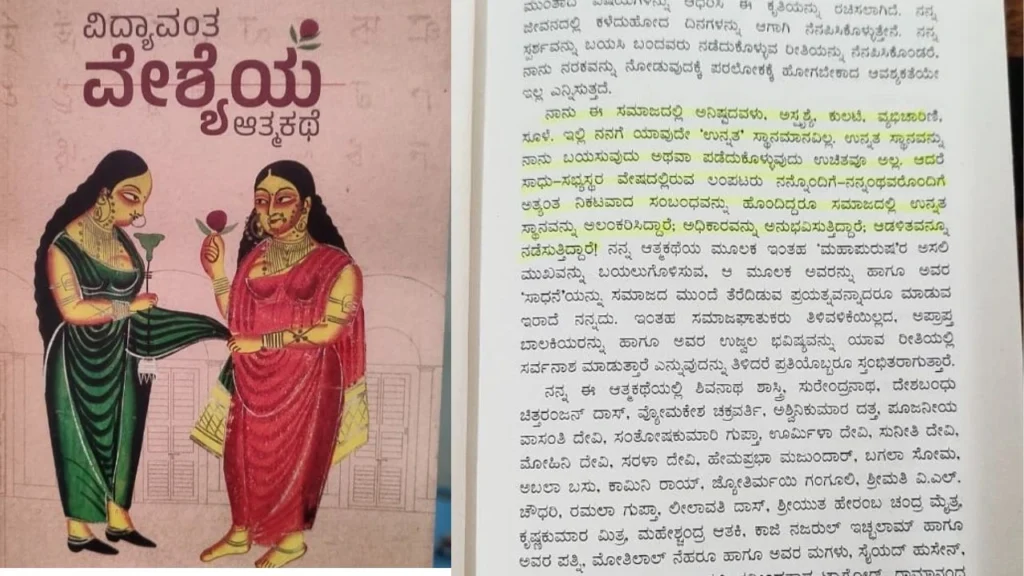
This is the story of a woman who lost her way in life — Vidyavanta Veshyeya Atmakate.
Originally, it is a Bengali novel written and published in 1929 with the name Shikshita Patitar Atmacharit. It is an autobiography of the author, Manada Devi Praneeth. This book received a huge response at that time. Within just one month of its release, around 16000 copies were sold. It was also translated into English and many other languages. This clearly shows how much attention this story got. Maybe because it spoke openly about things that people usually avoid talking about. In English, it was published under the name Autobiography of an Educated Fallen Woman. It is also referred to as An Educated Woman in Prostitution.
Even today people debate the authenticity of this book – “Did a prostitute really write this? Or was it written by a man?” Many are not sure whether Manada Devi herself wrote this novel. Some believe it is her true story, while some say it might have been written by someone else using her name. But whatever it is, the story feels very real and disturbing.
Manada was a well-educated girl from an upper-class family who studied in the reputed Bethoon School in Calcutta, and ended up in prostitution. And it really makes you think… This complete book is about Manada’s life, how her fate turned her into a sex worker during colonial Bengal, and how she excelled in her profession.
Vidyavanta Veshyeya Atmakate is a very bold and unhesitatingly written autobiography by Manada Devi Praneeth. She starts her book with a question to society:
“If I am called a fallen woman or a prostitute without any values in society, what do you call all those so-called dignified men who come to me?”
And that question is really thought-provoking.
Manada, fondly called “Mani/Manu” by her family and friends, grew up with all the luxuries in life. Her father, whose name is intentionally hidden in the book, was a well-known lawyer in Bengal. He believed in educating women and giving them equal freedom as men. Maybe that was the major setback in Manada’s life, as she has mentioned in her book. She says maybe her life would have been different if her family hadn’t given her that much freedom in childhood.
Manada lost her mother when she was just 5–6 years old. Since then, she felt lonely. Her father remarried a younger girl who was just 2–3 years older than Manada. After that, Manada felt even more lonely, as her father started spending more time with his new wife. It was then that Manada started hanging out with friends more. Along with studies, Manada had an interest in reading books, attending social concerts, and watching dramas and films. She had a good taste in literature, used to read authors like Bankim Chandra, Sarath Chandra, and Tagore. She was enjoying her life to the fullest. As she reached adolescence, she began to experience those natural desires. In that phase of confusion and lack of awareness, she got into a physical relationship with her cousin brother. Before she even realised what it was (love or lust), she became pregnant at the age of 14–15.
Scared of her family, Manada left her home with him. For the next 5–6 months, they wandered all over India; they were on cloud nine. Everything felt exciting. But slowly reality started showing itself. By the time she understood Ramesh’s truth, it was too late. He abandoned her after a few months, and she was left alone to face everything.
She went through many struggles in life. And finally, she chose to become a sex worker. It’s not like she never got better chances to lead a life in a good way. But it was completely her desire for luxury life, her lust, and the wrong decisions that made her choose this life.
But at this point, one question naturally comes to mind — why did she do it?
Manada herself answers this very honestly. She admits that she never learned self-control in life. Instead of controlling her natural desires, she kept encouraging them. From a young age, she had a rebellious mindset against social restrictions and never focused much on strong values or discipline. She clearly says that she became an example of how a young girl, without proper guidance and maturity, can easily fall for a man’s words and get cheated.
What makes this story even more striking is that Manada was not from a poor or helpless background. She was educated, from a well-off and respected family, and still ended up in prostitution. This breaks the common belief that only poverty or lack of education leads women into this profession. The book shows that this reality is not limited to any one class or background. At the same time, it reflects a society where men from high status continue to live with respect, even after being part of such a system. This contrast makes the story more disturbing and thought-provoking.
In the whole book, Manada never justifies her decision. She clearly says it was her choice, not under anyone’s force. What she questions is how society treats women like her. At many places, Manada herself feels guilty about her life. At the same time, she also questions society. This mix of guilt and questioning makes the book feel very real.
Along with her personal life, Manada also talks about the freedom movement happening in India during that time. She mentions that she witnessed and even took part in some of those moments. She participated in the Non-Cooperation Movement led by Gandhiji. She also helped in raising funds for cyclone victims in Bengal, along with other women in her profession.
She also had indirect connections with important people of that time like Rabindranath Tagore, Gandhiji, and Chittaranjan Das. Even though society looked down upon women like her, people like Chittaranjan Das treated them with respect and even accepted the funds raised by them for social causes. At the same time, not everyone supported their involvement, which again shows the mixed mindset of society.
Manada also shares the stories of other women in the same profession.
It felt very disturbing. She says not everyone entered this profession by their own choice. Some women were forced into it by their own families. Some were pushed into it by their husbands. And many women from well-respected families ended up here after losing their husbands, with no support left. It clearly shows the dark side of what we call a “respectable society.” The same society that looks down upon prostitution is also, in many ways, responsible for pushing these women into such situations.
At the same time, the book does not exclusively blame all the men as bad. Along with such men who treat women like property, Manada also mentions a few good people in her life — people who treated her with respect and did not see her just as a body.
One more thing that she openly admits is something not many would talk about. She says that women in this profession are always trying to attract men, no matter the place or situation. Even during serious moments, they would look for opportunities to find new customers. This honesty may feel uncomfortable, but it shows the reality of survival in their lives.
Though she participated in many social activities and even donated money for social causes, she never really took pride in it. Somewhere deep down, she knew she was not completely honest or committed to those efforts. She herself admits that she could not stay true to such causes because of a lack of self-control and sincerity. At the same time, she continued her life of entertaining wealthy men, trading her body for money and luxury. During this phase, she even took different identities like Feroza Bibi and later Miss Mukherjee.
What makes this book different is its honesty. She does not try to look good in front of society. She just tells her story as it is.
Towards the end, Manada makes her purpose very clear. She does not write this book to gain sympathy, but to show reality. She believes society also needs to change. Learn to be kinder and not just judge. She points out that families also play a role in a girl’s life. The way a child is brought up, the freedom, the guidance, everything matters. One mistake at a young age should not destroy a woman’s entire life.
More than anything, her story leaves behind an important lesson for parents. It shows what can happen when children are ignored, especially during their teenage years when they need guidance the most. She clearly suggests that change should begin from within the family. In the end, she expresses a deep wish that no one should suffer like she did, and no one should be forced to choose such a path because of a lack of love, care, and guidance.
ಇದು,
ವಯೋಸಹಜ ಕಾಮದ ಬಯಕೆಯನ್ನು ನಿಯಂತ್ರಿಸಲಾಗದೆ ವೇಶ್ಯೆಯಾದ ಒಂದು ಹುಡುಗಿಯ ಕಥೆ…
ತಂದೆಯ ನಿರ್ಲಕ್ಷ್ಯಕ್ಕೆ ಒಳಗಾಗಿ ಒಂಟಿಯಾಗಿಬಿಟ್ಟ ಒಬ್ಬ ಮಗಳ ಕಥೆ…
ವಿದ್ಯಾವಂತಳಾಗಿದ್ದರೂ ಜೀವನದ ನಿಜವಾದ ಮೌಲ್ಯವನ್ನು ಅರಿಯದೇ ದಾರಿ ತಪ್ಪಿದ ಒಂದು ಹೆಂಗಸಿನ ಕಥೆ…
“ಪತಿತೆ” ಎಂದು ಅವಳನ್ನು ಕರೆದು, ತಮ್ಮ ಮೋಜಿಗಾಗಿ ಅವಳನ್ನೇ ಹುಡುಕಿಕೊಂಡು ಬರುವ ಸಮಾಜದ ಕಥೆ…
ತನ್ನಂತೆ ಇನ್ನಾವ ಹೆಣ್ಣುಮಗಳು ಈ ದಾರಿಗೆ ಬಾರದಿರಲಿ ಎಂದು ಹಾರೈಸಿದ ಒಂದು ವೇಶ್ಯೆಯ ಕಥೆ…
ಕೊನೆಯಲ್ಲಿ, ಏನೇ ಆದರೂ ಹೆಂಗಸನ್ನೇ ತಪ್ಪುಗಾರ್ತಿ ಮಾಡುವ ಪುರುಷ ಪ್ರಧಾನ ಸಮಾಜದ ಕಥೆ…ಇದು, “ವಿದ್ಯಾವಂತ ವೇಶ್ಯೆಯೊಬ್ಬಳ ಆತ್ಮಕಥೆ”
