Book: Chomana Dudi
Author: Kota Shivaram Karanth
Language: Kannada
Genre: Social Realism / Social Novel
First Published: 1933
Pages: ~150–170 (varies by edition)
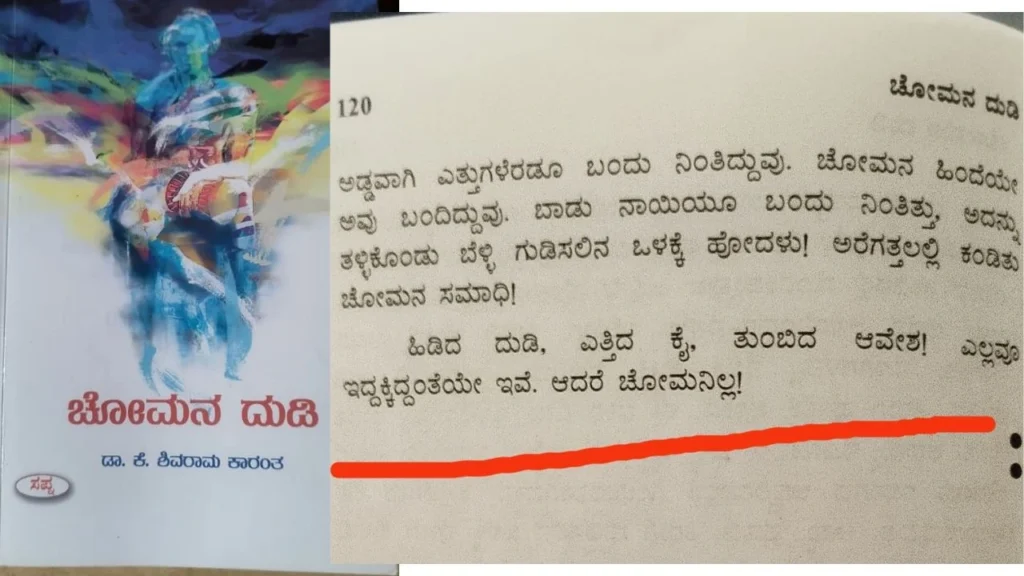
ಹಿಡಿದ ದುಡಿ, ಎತ್ತಿದ ಕೈ, ತುಂಬಿದ ಆವೇಶ! ಎಲ್ಲವೂ ಇದ್ದಕ್ಕಿದ್ದಂತೆಯೇ ಇವೆ. ಆದರೆ ಚೋಮನಿಲ್ಲ!
As I finished reading last lines of the book, tears fled from my eyes. I was hoping for a better ending for Choma. But maybe death was the easiest way out for him. These are the lines that haunted many from the book – Chomana Dudi.
Some people are not just poor in money… they are denied dignity, respect, and even basic human rights. We often talk about equality, but do we really understand what it means to live without it?
This book is not just about one man’s struggle… it is about a life where no matter how hard you try, society never lets you rise.
Chomana Dudi is considered one of the finest works by Kota Shivaram Karanth. It touches upon many aspects of society that existed during the early decades of the 20th century. It is about untouchability, rigid casteism, and social disparity practised in society during the period 1920–1940.
As you read through the pages of Chomana Dudi, you realise how harsh and difficult the lives of Dalits and untouchables were in the pre-independence era. Shivaram Karanth touches hearts through his powerful narration of the protagonist, Choma. The story feels so real that the reader cannot help but feel sympathy for the condition of Dalits during that time.
The story revolves around Choma, a Dalit who has lost his wife and is living a miserable life with his five children in a small hut. Dudi means a hand drum, an instrument played by Choma. Chomana Dudi literally means “Choma’s Drum.” In another sense, Dudi also refers to work or service.
Choma works in his landlord Sankappayya’s fields and house the whole day. At the end of the day, he used to get some rice, which was the only way he had to feed his family. Yet, he had only one wish in his life – to till his own land before he dies. But the Dalits were never allowed to own or till their own land. Choma tried to express his desire to his landlord, Sankappayya, but the caste system failed him.
Whether in joy, or sadness, or disappointment, the only way Choma had to show that was by beating his Drum. Choma’s drumbeats had no raga/tala. Just like his life.
His life takes a tragic turn when he is called to work in a coffee estate to repay his previous debt of Rs. 20. Old Choma could not go, so he sent his two elder sons — Guruva and Cheniya.For Choma’s misfortune, his sons also failed to repay his debt. Guruva never turned back. And he converted to Christianity by marrying Mary. Cheniya died of malaria.
After the loss of his son Cheniya, Choma loses interest in work and starts staying in the hut with his Dudi/Drum most of the time. But Manvela (estate’s writer) came to Choma again for the pending debt. This time, Belli goes to the estate to repay her father’s debt. During that process, young Belli becomes the victim of Manvela’s lust. After some time, Choma even loses his younger son Neela, who drowns in water. Nobody lends a helping hand just because he is an untouchable.
Loss of Neela deepens Choma’s disappointment with life and the caste system. Helpless Choma and Belli have no other option than to go back to their Dhani Sankappayya. But his deep desire to own and till land makes him think of converting to Christianity. As he was baited by a Christian father previously, “if at all he wants to own a land, he must convert to Christianity.”
What happens next to Belli, to Choma’s last remaining hope of tilling his own land, and to Choma himself is really heartbreaking. I will not say more….. But I was really in tears. The last lines of this book broke me completely. made me imagine his life, the situation of brave girl Belli, and their pet Baadu. It ended for everyone. Left with many questions and guilt.
I felt guilty, because I am also part of the same society which failed Choma. Guilty, because Manvela and others never thought about untouchability when they exploited Belli. But the same people did not help little Neela when he was drowning in water. Choma never asked for any luxuries in life. All he desired was a small piece of land to till his own crops. Just to fill his stomach.
It’s not just the story of Choma. It’s the story of thousands of people who were oppressed under this caste system. I am left with a question in mind: who created the caste? Is it God who created or ourselves? What was the mistake of Choma and his family? Is it just that they were born as Dalits?
A few things Shivaram Karanth boldly expresses in the novel are the exploitation of helpless girls and the issue of religious conversion. Maybe these things were present then and now also.
Even today, Chomana Dudi stands as one of the finest masterpieces of Shivaram Karanth. It deals with a socially powerful subject. But Karanth narrates it in a very simple and human way without turning the story into a political argument. That shows his strength as a storyteller.
In the end, the novel closes with a symbolic scene — Choma beating his Dudi again and loudly. Pouring out all his pain, anger, and disappointment through his drumbeats. Those drumbeats have no raga or tala. Just like his own life. And while beating the drum, Choma breathes his last.
That is what makes Chomana Dudi unforgettable. It is not just the story of one man. It reflects the silent suffering of thousands of people who were denied dignity because of the caste system. Even after finishing the book, Choma’s drumbeats continue to echo in the reader’s mind. And they stay with the reader long after the book is finished.
Similar Reads – Jalapatha By S.L. Bhyrappa
