Book: Rich Dad Poor Dad
Author: Robert T. Kiyosaki
Genre: Personal Finance / Self-help
First Published: 1997
Pages: ~330
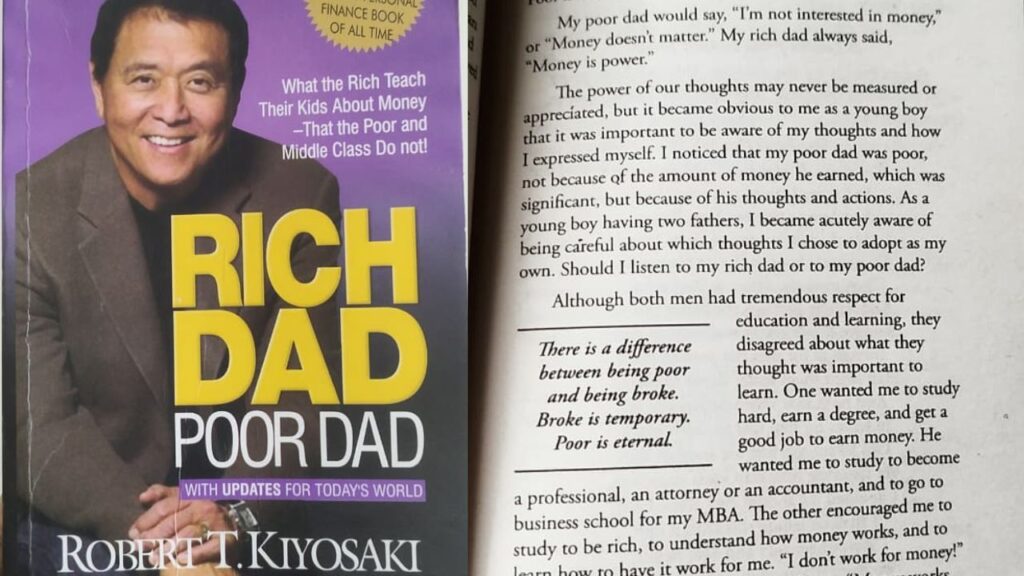
“Don’t work for money. Make money work for you.”
This is one of the popular lines from the book Rich Dad Poor Dad by Robert T. Kiyosaki. You may have already come across this quote somewhere, even if you haven’t read the book.
We all grow up thinking education is the key to success. Study well, get a job, earn money — that’s the path we are taught. But what if everything we learned about money is wrong? This book is not just about earning… it is about understanding money.
I had been seeing this book everywhere, on Instagram, YouTube, and even my friends suggested it. Many people say this book can completely change the way you think about money. So I thought to give it a try.
Honestly, I don’t know if I understood everything in the book properly. Maybe I am still new to reading finance related books. But still I could understand the basic idea that the author is trying to share.
Rich Dad Poor Dad book talks about two father figures in the author’s life. One is his real father, whom he mentioned as poor dad. And the other one is his friend’s father, whom he referred to as rich dad. Through their thinking and life choices, the author explains two completely different approaches towards money. The “poor dad” believes in studying well, getting a secure job, earning a salary, and living a stable life. This is something most of us are taught from childhood. The “rich dad,” on the other hand, believes in learning how money actually works. He focuses on building assets, investing, taking risks, and not depending only on a monthly salary.
So it is not really about being rich or poor in terms of money. It is more about the mindset and how a person handles money in life. It is more about how they think about money.
This contrast is the main base of the book.
Even though I didn’t connect deeply with the book, a few ideas stayed in my mind.
One important concept is about assets and liabilities. The author explains that assets are things that bring money into your pocket, and liabilities are things that take money away from you. It sounds simple, but in real life, we often confuse the two.
Another idea is about financial education. We spend years studying for a job, but very rarely learn how to manage money, save it properly, or invest it. This book keeps reminding us that financial knowledge is equally important.
The author also talks about how fear and comfort keep people stuck in one place. Many people don’t take risks because they are afraid of losing money. At the same time, they also don’t try to learn new ways of earning.
There is also a strong focus on changing mindset. Instead of saying “I can’t afford this,” the author suggests asking, “How can I afford this?” It is a small change in thinking, but it pushes us to find solutions.
At the same time, I didn’t feel very connected to the book as a whole.
Some parts felt repetitive, where the same ideas were explained again and again. Also, it didn’t feel like a smooth story. It is more like the author sharing his thoughts and lessons directly. Since I am not from a finance background, I also felt that I may need a more basic understanding before fully connecting with this book.
But I can understand why many people recommend it. It introduces a completely different way of thinking about money, which most of us are not used to.
The ideas are simple and easy to understand. It makes you think differently about money and earning. Good starting point for beginners in finance. Focuses more on mindset than complex concepts But it is not very engaging as a story. Some ideas felt too general or already known
It is one of those books where the value depends on the reader. If you are completely new to finance, this book can give you a new direction. But if you are expecting something very deep or practical step-by-step guidance, you might feel it is too basic.
For me, it was a decent read. It gave me a few useful thoughts, even if I didn’t connect fully with everything. Maybe this is a book that needs to be read at the right time in life to truly understand it.
At the end, one simple question stayed with me: Are we only working for money… or are we actually learning how to manage it?
If you like simple life lessons, you can also read:
