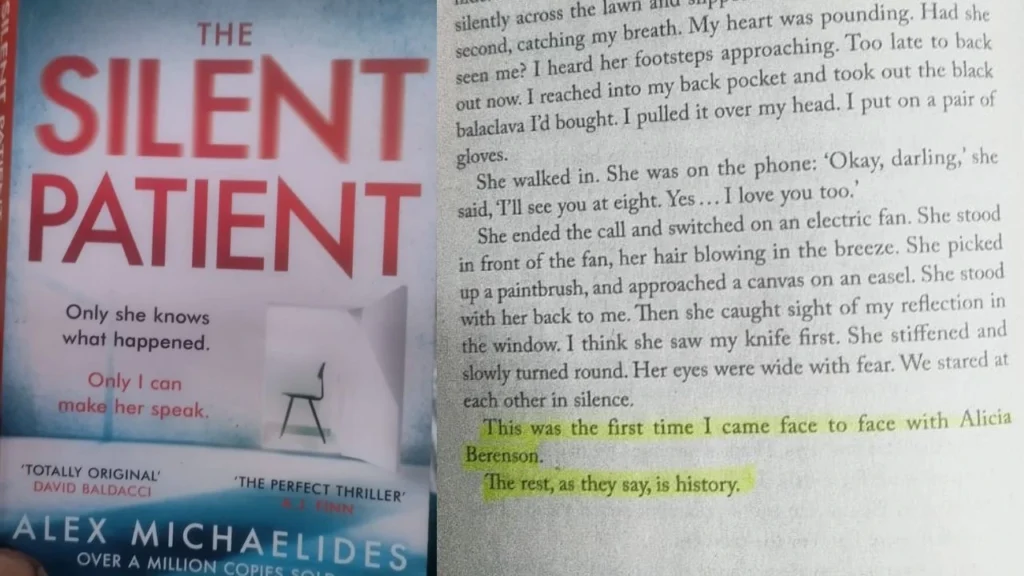
I haven’t read any suspense thriller or murder mystery in English before this. So, obviously, this book amazed me. Being a person who always thought childhood traumas play a major role in life, The Silent Patient made me pick it up without a second thought. I agree that there are some minor flaws in the writing, but as a whole, I enjoyed reading it. Especially if you’re new to the thriller genre, you will definitely love reading it (without any heavy expectations).
Written by Alex Michaelides as his debut book, The Silent Patient is a psychological thriller cum murder mystery. Having two main characters (protagonists), the story starts with a murder scene in a dark house. Alicia Berenson, who is a celebrated artist/painter, is found in a still position in her house, with blood splattered all over the place and a gun in her hand. Her husband, Gabriel (a famous photographer), is seen tied to a chair, dead, shot five times in the head. Looking at the crime scene, the police immediately arrest Alicia on charges of killing her husband Gabriel.
The whole story revolves around finding the real culprit. Is Alicia the real murderer? Or was there someone else in the house who did it? If it was Alicia who shot her husband, why did she do it? Because Alicia and Gabriel were happily married, well settled, and Alicia was deeply in love with Gabriel. If it was someone else, then why didn’t Alicia tell the truth to the police?
After that incident (after Gabriel is shot dead), Alicia goes completely silent. She remains silent when the police take her. She remains silent during the trial. She remains silent even when the media blames and defames her. Not just for a few days or months, she doesn’t speak a single word for the next 6 years. That’s why the name – The Silent Patient. Looking at her mental health, Alicia is kept in a psychiatric facility called “The Grove” in London. The only thing she does post is a mysterious painting — Alcestis.
But why Alcestis? In Greek mythology, Alcestis is a woman who dies willingly for her husband, is brought back to life, and returns completely silent after that. The pain of something unbearable leaves her with nothing left to say to the world. Alicia saw herself in that myth. But here’s what makes it interesting. Alcestis was betrayed by the person she loved most. So was Alicia naming this painting just a creative choice? Or was she leaving a clue? Was she also betrayed? By whom? And was her silence, like Alcestis, not madness, but a response to something she simply couldn’t put into words?
Alicia is one part of the story. Parallelly, our narrator Theo Faber, who is the second protagonist, narrates another story of himself and his wife, Kathy – their married life, how they met, his childhood, his relationship with his father, and everything. Theo is a professional psychotherapist who joins The Grove with the sole intention of treating Alicia. He wants to make her speak, to understand what went wrong with her, and what actually happened on the day her husband was murdered.
While the rest of the psychotherapists lose hope in Alicia’s case, things start improving after Theo joins The Grove. More than a psychotherapist, Theo starts acting like an investigating officer – he visits the crime scene, tries to understand Alicia’s childhood, meets her relatives and friends, and finally even reads her diary.
And one day, Theo finally succeeds in breaking Alicia’s silence of 6 years.
What made her speak, actually? Was it really Theo’s treatment method? Or his investigation and the past life talks that triggered her? Or something else, which only Alicia and Theo knew?
From here, the real twist of the story starts.
Upon insisting many times, Alicia finally speaks and reveals the truth of that night. The night that changed her fate, the night that silenced her. Did Theo actually believe her story? Did he accept what Alicia said about her husband’s murder and the real culprit? Well, if Theo had believed her, things would have been different. But he didn’t.
Why didn’t Theo believe her, even after she told him everything?
That is the real twist in the plot, something nobody saw coming. Till then, the narrator makes us believe that his intention is only to treat Alicia and bring her back to normal life. But no one questions why he is so personally invested in her case. What was his real intention? From here onwards, the story unfolds the tragic incidents in Theo’s life and slowly reconnects them to Alicia’s life.
The narrator fooled us very easily. It becomes difficult to understand the different timelines of the two stories. But the way everything connects in the end, with that major twist, is really gripping. It was truly a “jaw-dropping” moment.
There is no doubt that it is a good murder mystery by Alex Michaelides. But one thing that struck me as much as the story itself is the role of childhood trauma. Alicia had a painful childhood – abused by her father and never experiencing real love or affection. It shows how such traumas sit silently inside us. From the outside, everything may look normal and healed. But inside, those wounds keep building up. And one day, they explode, making us do things we never imagined. Maybe that is what happened with Alicia.
Oops! Did I mention that even Theo was a patient once? Yes – the psychotherapist Theo Faber himself had been seeing a psychiatrist for a long time. Then how could he treat Alicia? And how do we trust a story narrated by someone mentally unstable?
But still… we did.
That is actually the beauty of this book. The story is told from Theo’s point of view, and not the author’s. And he is not a completely reliable narrator. In fact, when you look closely, his thoughts, his actions, and even his relationship with Kathy show a lack of emotional depth and honesty. Somewhere, there is a lack of warmth in his life, and it slowly reflects in everything around him.
You can even feel that the people and spaces in the story start mirroring his inner world – cold, distant, and slightly disturbed. That’s why this book can be read in many ways. You can enjoy it as a straightforward thriller. At the same time, it is also a portrait of a deeply damaged individual – someone shaped by trauma, obsession, and betrayal. The writing from such a disturbed perspective is what makes the story feel more real and impactful.
Even the structure of the book – shifting between Theo’s narration and Alicia’s diary, slowly builds tension and confusion, which finally leads to that big twist that changes everything.
Finally, the book shows what happens when unhealed wounds explode one day. It shows the consequences of betrayal and pain in relationships. It shows the tragic story of Alicia, who remained silent forever after that night.
No… not just silent. This time, she was silenced forever.
But by whom and why is something you need to find out yourself. And the guilty are punished finally.
Similar Reviews:
