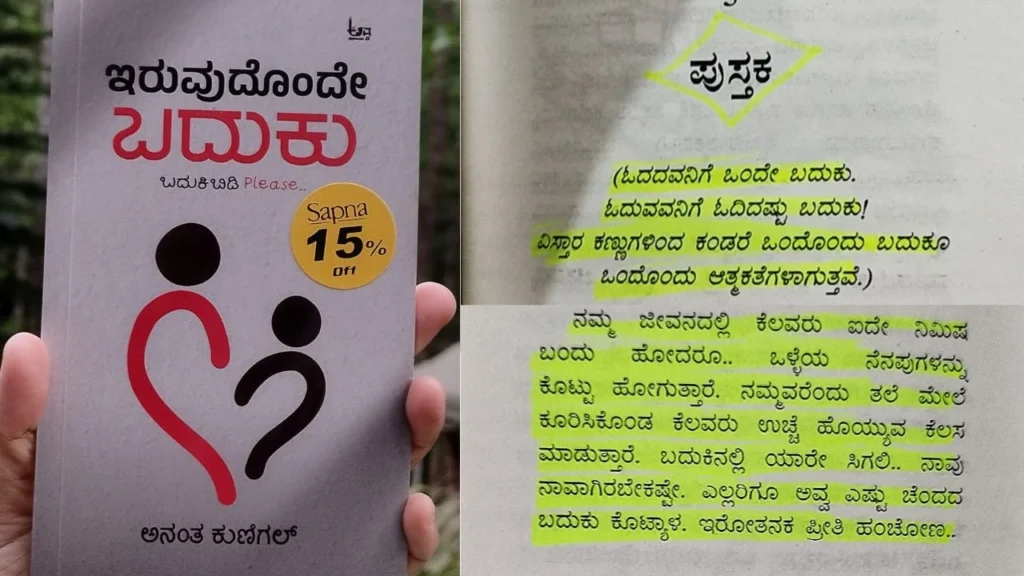
Book: Iruvudonde Baduku (ಇರುವುದೊಂದೇ ಬದುಕು)
Author: Anantha Kunigal
Language: Kannada
Genre: Motivational / Essays
Publisher: Avva Pustakalaya
Pages: ~132
ಇರುವುದೊಂದೇ ಬದುಕು.. ಬದುಕಿಬಿಡಿ ಪ್ಲೀಸ್… Iruvudonde Baduku… Badukibidi Please – is not the kind of book that teaches life through heavy philosophy or complicated words. It feels more like sitting beside someone who has seen life closely, someone who openly talks about happiness, pain, memories, people, relationships, village life, city life, dreams, disappointments, and finally tells us one simple thing — “Iruvudonde baduku… badukibidi please.” We have only one life. So live it fully.
The way Anantha Kunigal starts this book itself feels very unique and thoughtful. He talks about “5 chambers and 28 blood vessels.” Scientifically, we know a human heart has only 4 chambers. But here, the author uses it metaphorically. The book has 5 sections and 28 chapters, and he compares them to a living heart. As if every chapter is one blood vessel carrying different emotions, experiences, memories, and life lessons. That opening itself gives warmth to the reader.
Right in the beginning, the author jokingly says – “If you are above 35, don’t touch this book… unless some Jeevanotsaha (life enthusiasm) is still left in you.” That line immediately creates a connection with the reader. Obviously, he does not literally mean this book is only for youngsters. What he means is, this book is for anyone who still wants to celebrate life, observe life, and live with excitement instead of simply surviving.
And honestly, that itself becomes the soul of this book.
This is not a serious literary work filled with difficult language or complicated philosophy. It is written in very simple, present-day Kannada. What many people today call “instant literature.” The language feels conversational and natural. That is probably why the book has become so close to common readers. You never feel like somebody is lecturing you. Instead, it feels like somebody is simply sharing life experiences over a cup of tea.
The author keeps talking about ordinary things from daily life, but slowly turns them into meaningful observations. That is the beauty of this book. Many incidents he mentions are things we ourselves experience daily, but we usually ignore them saying “namagyake.” This book reminds us that the beauty of life lies in observing small things carefully.
The central idea of the book is very simple – happiness and sorrow are both part of life. Birth and death are fixed anyway. Between them, we have only one life. So instead of overthinking everything, why not live this one life fully?
That is why this book feels less like a motivational book and more like a “life enthusiasm” book. It slowly pushes us to reconnect with life again.
One line from the book especially stayed with me even after finishing it:
“ಓದದವನಿಗೆ ಒಂದೇ ಬದುಕು. ಓದುವವನಿಗೆ ಓದಿದಷ್ಟು ಬದುಕು!.”
“Those who read live many lives; those who don’t, live only one.”
Such a simple line, but it says so much. We get so busy surviving every day – work, responsibilities, stress, routine – that somewhere we forget to truly experience life. Books help us do that. Through reading, we experience different people, different emotions, different worlds, and different ways of thinking. Maybe that is why readers emotionally live many lives within one lifetime.
Interestingly, the author also discusses something very genuine about today’s reading culture. Whenever we ask readers about their favourite writers, most people immediately mention legendary names like S. L. Bhyrappa, Poornachandra Tejaswi, Kuvempu, or other senior writers. Their greatness is unquestionable. But very rarely do we speak about younger, emerging writers.
Anantha Kunigal openly talks about this “stubbornness” of readers. He explains how new writers are constantly compared with literary giants, and because of that, many fresh voices never truly get accepted. Along with readers, he also discusses the struggles of publishers and self-publishing. Those portions feel very honest because they come from his own experience as a writer.
At the same time, he respectfully talks about writers like Purna Chandra Tejaswi and S.L. Bhyrappa, especially discussions around Parva, which literature lovers will definitely enjoy reading.
One major discussion throughout the book is about village life and city life — Halli mattu nagara baduku jataapati. The way the author explains this conflict feels extremely relatable today. He compares the city to a huge ocean. From far away, it attracts everyone with lights, opportunities, money, dreams, and freedom. Slowly, people leave villages and move towards cities hoping for a better life. But after some time, the same city life starts becoming exhausting and suffocating.
Then suddenly we begin missing village food, slow evenings, neighbours, open roads, human connection, and the peaceful atmosphere of our hometown.
The author beautifully explains how many of us today are emotionally stuck in between – physically living in cities, but mentally searching for the peace of villages.
His childhood memories about Ganesh festival also feel very nostalgic. Earlier, festivals were about togetherness. Collecting small amounts of money, decorating streets, singing songs throughout the night, laughing together – all these created unity among people. But today, the author feels festivals are slowly becoming reasons for division, ego, politics, and unnecessary conflicts. That observation feels sad but true.
Another important thing he discusses is the condition of Kannada language, especially in Bengaluru. He emotionally points out how some children are made to feel inferior for speaking Kannada even inside Karnataka. Without sounding aggressive, he raises an important question about identity, language, and cultural disconnect in modern cities.
The book also feels very relevant to today’s digital generation. The author speaks about social media addiction, followers, likes, views, online validation, and contradicting comments. Slowly, people are forgetting real life while trying to impress strangers online. Even simple technologies like UPI are changing the lives of small business owners and reducing human interaction little by little.
One thing I really liked is how naturally he connects these modern topics with emotions and everyday life. Nothing feels forced.
Another emotional portion in the book is about fatherhood. The author explains it through a hospital situation when his brother’s wife is admitted for delivery. Watching his pain and struggle makes him realise how difficult becoming a father actually is. Society often talks emotionally about motherhood, but very rarely about the silent emotional pressure fathers go through. That observation felt very genuine and mature.
The author repeatedly reminds us that as days pass, memories should continue blooming. Otherwise life slowly becomes “sappe” – tasteless and mechanical. We should laugh, cry, travel, meet people, build hobbies, and experience different emotions. Only then life feels alive.
He also says something very meaningful – there are many ways to live life. Depending completely on one path, one dream, one person, or one identity and emotionally hanging onto only that is not healthy living. Life becomes beautiful only when we continue exploring it.
Personally, I felt this book is very helpful for people who are emotionally tired, mentally stuck in routine life, or slowly losing excitement towards life. It does not suddenly motivate you with dramatic quotes. Instead, it quietly changes your perspective little by little.
While reading this book, I honestly felt the author was indirectly asking us one question again and again:
“When was the last time you actually lived happily without overthinking life?”
That question itself becomes the impact of this book. And finally, the book ends with a very emotional truth that almost everyone will relate to:
No matter how much we travel, finally our own village feels the most beautiful. No matter how many people exist around us, in the end, a mother’s lap feels the safest.
That feeling silently stays in the heart even after finishing the book.
For me, this was not just a book about motivation or life lessons. It felt more like a reminder. A reminder that life does not always need grand success or extraordinary achievements to feel meaningful. Sometimes, good memories, good people, conversations, books, travelling, festivals, family, language, laughter, and peace are enough.
Maybe that is why the title itself feels so beautiful and meaningful —
Iruvudonde Baduku… Badukibidi Please.
We have only one life. Please… live it.
“ನಗು ಬೇಕು, ಅಳುವೂ ಬೇಕು
ಗೆಲುವು ಬೇಕು, ಸೋಲೂ ಬೇಕು
ದಿನಗಳು ಉರುಳಿದಂತೆ,
ನೆನಪುಗಳು ಅರಳುತ್ತಾ ಹೋಗಬೇಕು
ಜನರ ಜೊತೆ ಬೆರೆಯಬೇಕು
ಸುತ್ತಾಡಬೇಕು
ಭಗವಂತ ಕೊಟ್ಟ ಈ ಬದುಕನ್ನ ಅನುಭವಿಸಬೇಕು…
ಆದ್ದರಿಂದ,
ಸ್ವಲ್ಪ ನಗೋಣ
ಸ್ವಲ್ಪ ಅಳೋಣ
ಸ್ವಲ್ಪ ಸುತ್ತಾಡೋಣ
ಸ್ವಲ್ಪ ಓದೋಣ
ಸುತ್ತಲಿನ ಜನರನ್ನ ಪ್ರೀತಿಸೋಣ
ಹಳೆಯದನ್ನ ಮರೆಯದೆ, ಹೊಸದನ್ನ ಸ್ವೀಕರಿಸೋಣ
ಯಾಕಂದ್ರೆ,
‘ಇರುವುದೊಂದೇ ಬದುಕು…
ಸ್ವಲ್ಪ ಬದುಕಿಬಿಡೋಣ…’

Thank you so much for your valuable points on my book. Im greatful to have such a reader like you. 😍💐