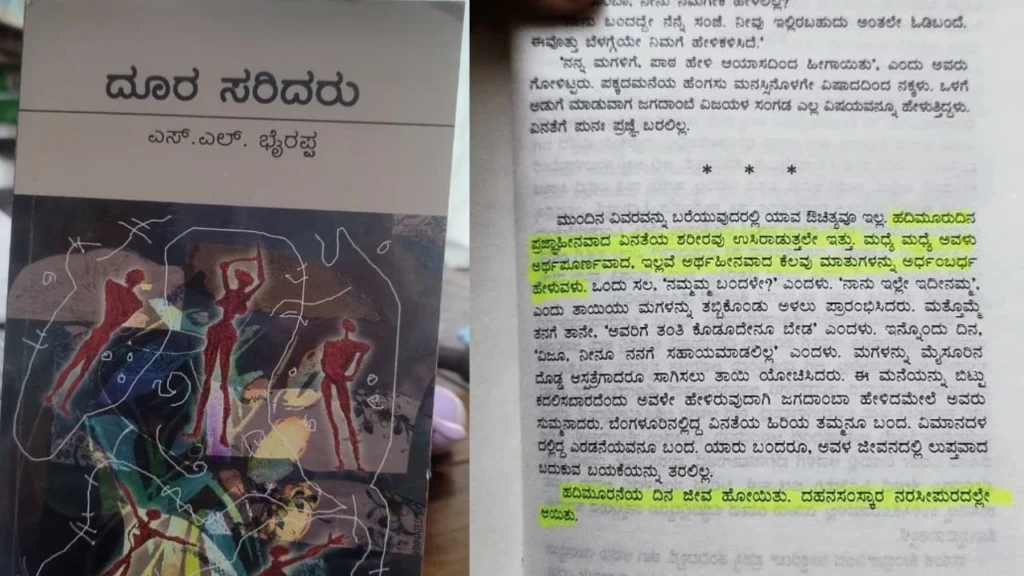
Book: Doora Saridaru (ದೂರ ಸರಿದರು)
Author: S.L. Bhyrappa
Language: Kannada
Genre: Literary Fiction / Philosophy / Romance
Publisher: Sahitya Bhandara (based on edition)
Pages: ~300–350 (may vary by edition)
This is my second novel by S.L. Bhyrappa after Jalapatha. Like many of his novels, Doora Saridaru is also a deeply thought-provoking book that pushes readers to think beyond the surface of relationships. One of Bhyrappa’s greatest strengths is explaining complex ideas through simple stories, and that strength can be seen beautifully in this book too.
When I first heard about it,a love and romance novel by S.L. Bhyrappa, I was a little skeptical. Most of his books rely heavily on philosophy and encourage readers to think deeply about life. Doora Saridaru, as the title suggests, belongs to the romance genre. I have read a few Kannada books in this genre before, and many of them depend heavily on sentiment and emotions. But Doora Saridaru is definitely different.
It is not about one love story, but five different stories. Each one teaches something unique. The book is a beautiful blend of emotions and philosophy.
Each relationship in this book has a different foundation. They begin differently, grow differently, and end differently. It ultimately shows how we human beings have different thought processes, opinions, and priorities in life. Yet we constantly expect the other person, especially our partners, to align with our opinions and mindset, forgetting their own individuality. S.L. Bhyrappa has shown beautifully how these differences, along with our own ego, can spoil even a good relationship. Sometimes, it not only ends relationships but also ends our own happiness.
For ordinary readers like me, this book is about emotions, relationships, and the sadness that sometimes follows. But for students of philosophy, Doora Saridaru feels like a feast. There is plenty to explore and learn from a philosophical angle. It is amazing to see how naturally the author has written such different characters and viewpoints. Without that deep understanding of life and philosophy, it would not be easy to create characters with such depth. There is not one protagonist in this story – every character is a protagonist.
As usual, like many classic love stories, this plot also begins in a college in Mysore during the 1960s.
The story starts with Sachhidananda, an English Literature (Honours) student who lives with his mother. He is humble, intelligent, and academically brilliant, with a deep interest in literature. In the same college, there is another student called Vinata Kumari, fondly called Vinata. She is bright, beautiful, and equally interested in literature and writing poems and stories. Gradually, without even formally expressing their feelings, they understand that they are in love. Their relationship is built mainly on emotions and literary interests.
Parallelly, another story unfolds through Vasanth and Uma, who are philosophy students. Uma is Vasanth’s junior in college. Unlike Sachhidananda and Vinata, Vasanth and Uma believe more in philosophy than emotions. They have different perspectives towards love and life. Vasanth is an introverted person who spends most of his time reading and exploring philosophy. The only place where he is not an introvert is during debate competitions – there, he becomes a completely different person. Uma shares the same interest in discussions and intellectual debates. Slowly, their similar way of thinking and shared interests make them another couple in college. More than emotions, their relationship is based on ideas and thinking.
Then there is Vijayakumari, Vinata’s elder sister. Though she loved Ramamurthy in her college days, she later gave up on that relationship and chose another path in life.
Another interesting and emotional character in the story is Rama. She had lost almost everything in life, even her parents, at a very young age. Yet she remained cheerful, kind-hearted, and positive. She loved Sachhidananda with pure intentions, but life had different plans.
The fifth story and probably the purest form of love and sacrifice I found in Doora Saridaru is that of Varadamma. Varadamma was a professor in the same college where Sachhidananda and Vasanth studied. Everyone only knew that she was a widow, but nobody knew the story behind it. Her story quietly becomes one of the most memorable parts of the novel.
Through all five of these stories, S.L. Bhyrappa lets us explore different angles of love and life. Each character has depth, uniqueness, and feels alive.
As the story progresses, the real philosophical strength of the novel slowly comes into picture. What starts like a normal college love story gradually becomes a reflection on relationships, marriage, individuality, ego, sacrifice, expectations, and human nature.
One thing I really liked about the novel is that Bhyrappa never clearly tells us who is right and who is wrong. Every character has their own philosophy and reasons behind their decisions. As readers, we are left to think and judge for ourselves.
As the title says, Doora Saridaru roughly translates to “Moved Away”. Everyone can guess from the beginning that people move away from each other. But the beauty of the novel lies in understanding why they moved away.
Through these stories, Bhyrappa also touches upon themes that still feel relevant today – caste, social status, parental pressure, education, expectations in marriage, and the difficulty of accepting people as they are.
When I started reading this book, the first few pages felt a little difficult because the language and word usage felt heavy. But as the story progressed, things slowly started falling into place. The situations became relatable and easier to connect with. At some points, I even felt a few characters were not fully explained or seemed unnecessary. But later I realised the beauty lies in how all the characters connect to the larger story. For example, even a young sage whom Sachhidananda meets in Bababudan Giri later turns out to have an interesting place in the story.
Even after more than sixty years, this novel still feels contemporary because human relationships have not changed much. They are still the complex ones.
Overall, Doora Saridaru was a memorable reading experience for me. If someone is expecting only a romantic novel, this book may surprise them. But for readers who enjoy philosophy, character-driven stories, and books that make them think deeply, this is definitely worth reading.
What I liked most at the end was how every character handled life in their own way after moving away from the people they loved. Some continued their studies, some built careers, some found purpose in different things, and some simply learned to live with their choices. That is where I felt the real meaning of Doora Saridaru lies.
This book is not just about love stories that begin at a young age. It is also about what happens later in life – how people deal with disappointment, how they move on, and how their experiences shape them.
But among all the characters, the one that stayed with me for days was Vinata. Her way of dealing with life was different. She believed in silently enduring pain and hoped time would solve everything. Throughout the book, I kept hoping that life would take a different turn for her and Sachhidananda. Maybe that is why her story stayed with me long after I finished reading.
ಸಾಹಿತ್ಯದ ಕಾವ್ಯ ಕಮರಿತ್ತು,
ತತ್ವದ ಒಣ ತರ್ಕವೂ ನಿಂತಿತ್ತು,
ಅವಳ ಭಾವನೆಗಳ ಆಳ ಅವನಿಗೆ ತಿಳಿಯಲೇ ಇಲ್ಲ,
ಅವನ ಸಿದ್ಧಾಂತಗಳ ಸತ್ಯ ಅವಳಿಗೆ ಒಗ್ಗಲೇ ಇಲ್ಲ.ಮಾತುಗಳಿಗಿಂತ ಮೌನದ ಅಹಂ ದೊಡ್ಡದಾದಾಗ,
ಬದುಕು ಮುನಿಸಿಕೊಂಡು ಮೂಕ ಪ್ರೇಕ್ಷಕನಾದಾಗ,
ಹೃದಯ ಮತ್ತು ಮೆದುಳುಗಳ ನಡುವಿನ ಕಂದಕವ ದಾಟಲಾಗದೆ,
ಅವರೆಲ್ಲರೂ ಅರಿಯದಂತೆ ತಮ್ಮದೇ ಜಗತ್ತಿನೊಳಗೆ ಒಬ್ಬರಿಂದೊಬ್ಬರು ‘ದೂರ ಸರಿದರು’…
