Jalapatha is a small novel yet a masterpiece by S.L. Bhyrappa. When we read through the book, it doesn’t even feel like it was written in the 1960s. Because the societal expectations, financial struggles in city life, complexities in relationships, burden women face due to childlessness, and many more things still remain unchanged. And that is what makes the novel still relevant and relatable even in 2026.
Sripathi is the protagonist of the novel Jalapatha, whose character is portrayed perfectly as an imperfect middle-class man by S.L. Bhyrappa. Sripathi is not shown as a perfect man with a happy wife and a happy family. Even though he has got the best wife, the imperfections of a human being are shown nicely in the story. Through this, the author tries to tell us that it is completely okay to be imperfect sometimes, because we are all human beings. We all make mistakes, but what we should not forget is to learn from our own mistakes.
The Clashing Worlds of Passion and Duty
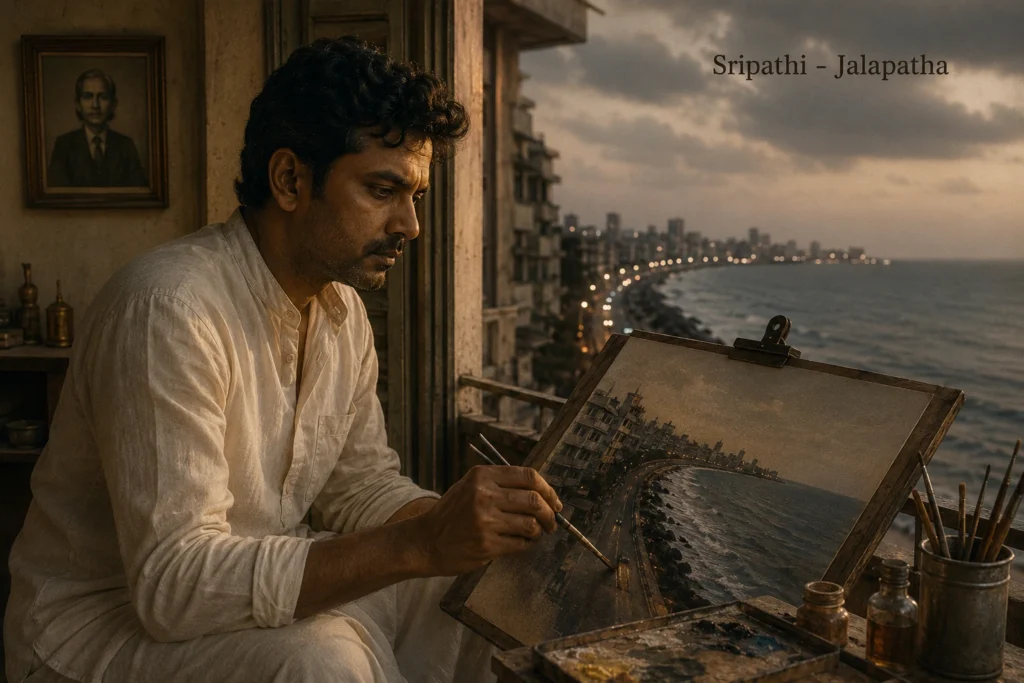
At the beginning of the story, Sripathi is shown as an aspiring artist from a small town. A simple village boy who was looked after by his uncle in Mysore. As life goes on, Sripathi reaches Mumbai to earn for his family. The reality starts showing him that passion and responsibilities cannot always go hand in hand. His passion was to become a great artist and do what he loved in life. Soon, he starts adapting to reality and takes up a job in an advertising company as an ad painter, with very little space for creativity. At this point, he is shown as a man with ambitions and passion in life who compromised for his family, just like many of us do.
What made me feel sad for Sripathi was not just the financial struggles. The misfortune that made him to move away from his artistic dreams. Painting was not just a hobby for him. It was something he truly loved. But as responsibilities increased, he had less freedom to do what he wanted. Many talented people face the same situation in life. Sometimes survival becomes more important than passion. Through Sripathi, Bhyrappa shows how reality can slowly take away the dreams we once had.
The Human Mistakes and Realisation
In the later part of the story, with his wife Vasu and son Vishwa, Sripathi is shown as a happy family man. In many places, he praises Vasu for her simplicity, adaptability, and joyfulness even in a difficult city life. Vasundhara is one of the strongest characters in the novel. She is not shown as a loud or extraordinary person, but her strength can be seen in the way she handles every difficult situation. She remains calm and practical in every situation and supported Sripathi in his hardships. Many times, it felt like she was the person holding the family together when life became difficult. Her sacrifices are quiet, but they leave a deep impact on the story.
Even though he has a loving wife and a beautiful son, Sripathi commits an extramarital affair with his colleague Rebello. At this point, I was a little disappointed because till then Sripathi felt like a hero to me, someone who was loved by everyone, both in the neighbourhood and in the office. But later, S.L. Bhyrappa slowly made me realise the reality that nobody is perfect. It also shows how common human desires are for anybody. Very soon Sripathi realises the mistake he is committing and corrects himself. At one point, he and his wife even decided to follow celibacy for some time in their married life to control their desires. He is a man who learns from his mistakes. A simple, intellectual, thoughtful, hardworking, and joyful personality.
Sripathi always had a broader perspective towards life. Yet he was also a person with deep philosophical beliefs. He was often lost in his own thoughts, looking at the Mumbai sea waves from his balcony. He believed that if a married couple does not want to have kids, then they should stay away from physical relationships. According to his philosophy, the main purpose of a physical relationship between husband and wife was to have children. This is completely different from another character in the novel, Dr. Nadagowda, who believed that physical contact and having children are two different things. It is completely up to the couple whether they want to have children or not.
Deep Respect for Motherhood
When Vasundhara conceives their second child, Sripathi is shown as a caring and loving husband. He takes her on picnics every month and captures the changes happening in her body during pregnancy through beautiful paintings. He compares those changes to nature and the way it changes with the seasons. He admires her beauty, respects womanhood, and remains grateful for the sacrifices women make to bear a child in their womb.
The way he explains labour pain is worth reading. He describes it as something most painful, courageous, and one of the greatest sacrifices a woman can make for her family.
If you think his life had a happy ending after the birth of the second child, you are wrong. Life starts throwing more struggles at him. He suffers mentally and financially and eventually returns from Mumbai to his native place. That shows how we also hope for a better and peaceful life somewhere else when difficulties arise. He leaves behind his house, artistic dreams, and city life and settles for farming on his own land.
At first, Sripathi thought moving back to his native would give him more peace than Mumbai. He believes leaving Mumbai will solve many of his problems. But later he realises that every place has its own struggles. Life became so uncertain in village also. There is no perfect place where all problems disappear. This was one of the most realistic parts of the novel for me. Many of us think happiness is somewhere else, but when we reach there, a new set of problems is waiting for us.
When farming could not provide enough income for the household, he even starts working as a daily wage worker in the village. Life is not always fair, right? He also faces heartbreaking personal losses because of poverty and circumstances.
Through all these situations and decisions, Sripathi just looked like a common man like me, like you.
That is what makes Sripathi such a memorable character. He is neither shown as a hero, nor a weak person. He makes mistakes, but learns from them. He struggles with responsibilities, dreams of a better life, and keeps moving forward despite his many failures. In many ways, Sripathi is not just a character from Jalapatha. He represents many ordinary people who are trying to balance their dreams, family responsibilities, and reality.
Just like many other books by S.L. Bhyrappa, Jalapatha also presents many different personalities to show how different people have different thought processes and perspectives towards life. We cannot have everything in life. At the same time, we cannot keep everyone around us happy forever. What remains unchanged is the struggle. Nobody is perfect, and nobody is without pain.
The Philosophical Weight of Jalapatha
The title Jalapatha itself feels very meaningful after finishing the novel. A waterfall never stops flowing because of the rocks in its path. It simply finds a way to move forward. Sripathi’s life also felt like that to me. He moves from village to city and then back to the village. He experiences success, failure, happiness, loss, hope, and disappointment. Yet life keeps moving forward. Maybe that is why Bhyrappa chose the title Jalapatha. It is not just the story of one man. It is a reminder that change and struggle are a natural part of life.
Just like a waterfall keeps flowing despite the rocks in its path, we too have to face everything and accept life as it comes. Even though I tried my best to understand Sripathi’s character, many of my questions remained unanswered. Maybe that is the speciality of the author here. He does not judge anyone. He simply presents different situations and leaves the readers to understand them in their own way.
Through Jalapatha too, S.L. Bhyrappa has left us with many questions to think about and analyse for ourselves.
Also Read – Detailed Book Review of Jalapatha – By S.L. Bhyrappa
