- Title: Gaamini (ಒಳಗೊಳಗೆ ಹರಿಯುವವಳು – The One Who Flows Silently Within)
- Author: Shivaraj Yadav G. L.
- Publisher: Megha Prakashana
- Format & Length: Paperback, 120 pages
- Language: Kannada
- Genre: Contemporary Fiction / Romantic Drama / Social Realism
When I started posting about the books I read on my social media account, some authors started noticing my posts. Slowly, personal messages started pouring into my Instagram inbox. Some were about my posts, some were asking about my life, and some were requesting book reviews. I started getting complimentary book copies to read and post my reviews and opinions on their novels. This happened especially with young authors, or authors who had just started their writing journey.
Among them, Gamini – Olagolage Hariyuvavalu is the first complimentary book I received from the author, Shivaraj Yadav G.L., himself.
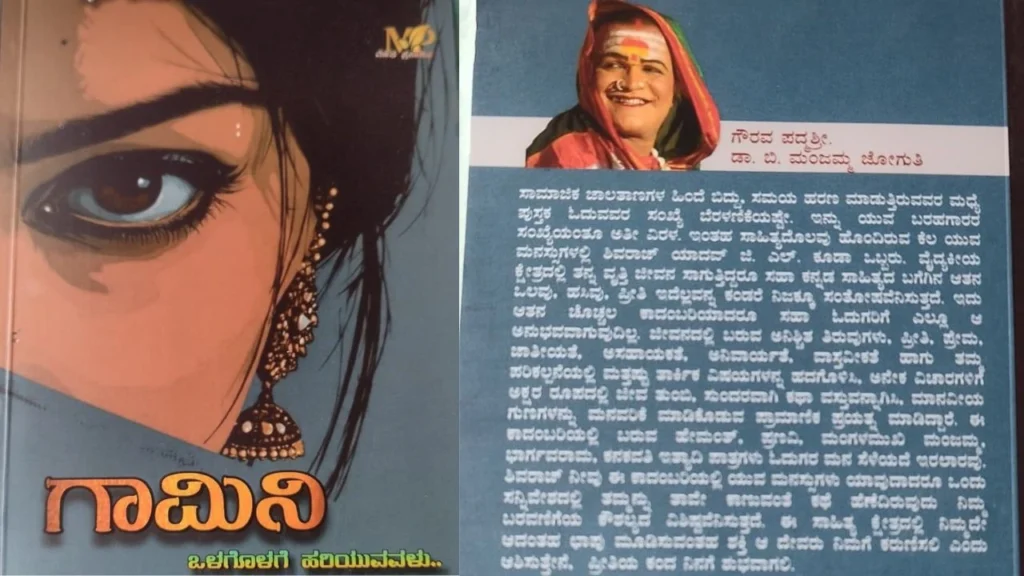
The book cover is really appealing, and it also says “Naija Ghatane Adharita“, which means it is based on true incidents. So I was really looking forward to reading it. As this book was already making some noise on social media, I picked it up to read. After finishing it, I had mixed feelings about the book. The author’s writing style is engaging, with clear and simple language that is easy for everyone to understand.
Gamini is a short, 120-page book, but the story is emotionally gripping. Although it falls short technically in some places, it has a gripping storyline. The story starts in a Government Medical College, with Hemanth as the male protagonist and Pranavi as the female protagonist. Hemanth, a village boy joins a professional lab technician course in a college in Karnataka. Along with his friends Pranavi, Manjamma, and Kotreshi, he enjoys college life. Kotreshi is Hemanth’s best friend, who is also from the same village, and stands by him in every situation. Manjamma is a good friend to everyone. Pranavi, who comes from a well-to-do family slowly falls in love with Hemanth, who is the son of a small farmer.
Like many love stories, they also face opposition from the family. Her mother, brother, and elder sister are very money-minded people. More than that, they care a lot about caste and social status. But Pranavi, unlike the other members of her family, wants to marry only Hemanth, even after knowing his family situation.
Slowly, Pranavi’s family starts forcing her to marry a rich guy who is already settled abroad. Though she is adamant about her decision in the beginning, she later agrees because of the pressure. And she also had fear that they might harm Hemanth. Her family thinks they have won in life by getting their daughter married to a well-settled man instead of Hemanth. But they are unaware of what has already happened in Pranavi’s life. Hemanth and Pranavi, who are deeply in love, believe that destiny will unite them one day. But after Pranavi’s marriage, life takes an unexpected turn, making their love story even more emotional.
Till this point, the story felt real and truly based on real incidents. But the author had different plans, maybe. Suddenly, the story shifts in a different direction. Totally a different paradigm, exploring soul connections and the concept of past births (Janma Janmanthara Sambandha). It was interesting to read and explore things from a different perspective. But at the same time, it also felt a little unnecessary in this book. The real story of Hemanth and Pranavi was developed really well and connected with readers. Like many others, even I was expecting a real-life ending to their love story. But when the story shifted towards the historical side, I felt a little disappointed.
Apart from that, the historical storyline and the portrayal of the characters Bhargava Rama and Kanakavati are done well. The author connects Hemanth and Pranavi to a story from their previous births, which becomes the biggest twist in the novel. That part was interesting to read, even though I personally felt the realistic story itself was strong enough to develop.
The preface (Munnudi) of the book is written by Manjamma Jogathi, a famous transgender folk artist who won the Padma Shri award. This gives more social value to the book. Interestingly, one of the important characters in the novel, Manjamma, is also a transgender woman. Portrayed with great respect and kindness. The novel highlights the harsh realities of our society. It shows how caste, money, and family status control marriages and destroy true love. It also reminds us that living abroad is not always as glamorous as it looks from the outside.
The author filled deep emotions into every character in the story, especially Hemanth and Pranavi. Their relationship is very powerful because they are deeply connected in love, but completely helpless against society and family. Pranavi always keeps her pain hidden, flowing silently with heavy emotions, just like the title of the book suggests – Olagolage Hariyuvavalu.
For me, it was a decent read. I was honestly expecting a better, real-world resolution for Hemanth and Pranavi in this lifetime. Connecting their relationship to a past birth felt a bit out of place. I personally felt the book would have been much better if the same realistic storyline had been developed till the end without changing the genre.
Overall, it is a good attempt by a debut author. Even though I was disappointed with the genre shift in the second half, I still enjoyed reading the book because of its emotional storyline and simple writing style. I will definitely look forward to reading more books from the author in the future.
Similar Reads – Doora Saridaru By S.L. Bhyrappa
