Book: Akramana (ಆಕ್ರಮಣ)
Author: Anantha Kunigal
Language: Kannada
Genre: Political Thriller / Suspense Thriller / Social Fiction
Publisher: Avva Pustakalaya
Pages: ~250–300 (may vary by edition)
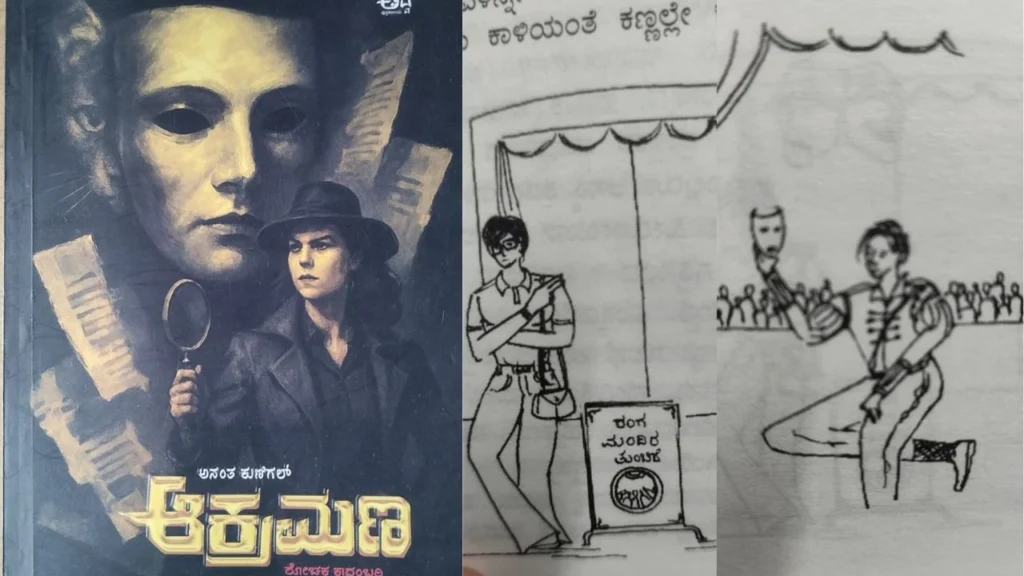
This is my second book by Anantha Kunigal after Iruvudonde Baduku, Badukibidi Please. One thing I have started noticing in his writing is that he doesn’t simply tell a story. He picks an ordinary topic, adds suspense around it, and slowly makes us think about society, people, and the system we live in. That is exactly what happens in Akramana too.
At first glance, Akramana looks like a political suspense thriller. But after reading it, I felt it is much more than that. It is a story about power, injustice, media, identity, and how easily people can be distracted from the real issues happening around them
Was it just a coincidence, or was it something else that made me pick up this book at this time? I am not sure. A book which I started reading as just another suspense thriller, slowly turned into a dark reflection of our society. Or maybe I can say, it showed me another face of politics, power, media, and even human beings.
Within a few pages, I realised this book is not for someone who is reading just for entertainment. Because it wants us to think, question, and even feel a little uncomfortable at times. That was the moment I understood this was much more than an ordinary suspense novel.
Before writing anything about this book, let me make one thing clear. I am not in favour of any political party. In fact, I have almost zero knowledge about politics, and honestly, I never liked discussing it. I am saying this because while reading this book, I was reminded of many incidents happening around us. It made me realise how easily people can be distracted by one issue, while something much bigger quietly happens in the background.
Just like the author’s previous book, Iruvudonde Baduku, Badukibidi Please, where he beautifully used the metaphor of arteries and blood vessels, Anantha Kunigal has once again used a powerful metaphor in Akramana as well. This time, it is bombs. But are they really talking about bombs? Or do they represent something much bigger?
Let’s find out.
The story mainly revolves around Rambo, one of the most mysterious characters in this story. Or maybe I should say… Rambos. Because throughout the novel, we never really know how many Rambos actually exist.
People know him only as Rambo, a theatre artist famous for performing Shakespeare dramas. But nobody really knows who he is behind the stage. Nobody has seen his real face without makeup. Nobody knows where he came from, where he lives, or what kind of person he is in real life. In fact, nobody even knows whether Rambo is one person… or many.
That itself becomes the biggest suspense in the story.
Another important character is Asma, a journalist working in Shakthi Media. She is assigned to write articles based on information given by a mysterious informer who keeps sending secret news to the newspaper. That informer is none other than Rambo.
Now think about it. A theatre artist, who spends most of his time acting on stage and drinking in his free time, somehow knows everything happening in the city even before it happens. He knows which politician is involved in corruption. He knows which place is going to be attacked. He even knows about a Kannada-medium school that is going to be closed before anyone else. How? That was the biggest question in my mind.
The more Asma investigates about Rambo, the more confused she becomes. Every clue she finds only creates more questions than answers. At one point she admires Rambo. At another point she dislikes his methods. She even saves two contacts in her phone as Good Rambo and Bad Rambo, because she herself is not sure whether she is dealing with one person or two completely different people.
Just like Asma, even I couldn’t decide whether to admire Rambo or fear him.
As the story moves forward, Rambo suddenly disappears after a series of incidents in the city. But strangely, the theatre performances continue as usual. That made me wonder again. Who is Rambo? Is he really one person? Or is Rambo simply an identity carried by different people?
The second half of the book slowly takes us into Rambo’s past. We begin to understand the pain that changed him and why he chose such a dangerous path. He is fighting a corrupt system in his own extreme way, living like an ordinary person but doing extraordinary things.
The connection between Agastya and Pushpa was something I never expected. I won’t spoil it here because that was one of my favourite moments in the entire novel.
After finishing the story, one question stayed with me. How many versions of ourselves do we actually have? A different person at home, another at work, another with friends. Sometimes we are kind, sometimes selfish, sometimes brave, and sometimes afraid. Maybe every person carries both good and bad within them. We judge people only by the side we happen to see, and that is exactly how Asma looks at Rambo. She never sees him as completely good or completely bad.
Now, coming back to the metaphor of bombs. At first, I thought they were simply bombs used in the story. But slowly I realised they represented the issues that keep society busy. Sometimes it is religion, sometimes caste, sometimes language, sometimes gender, or simply anything that has the power to divide people. Before we even stop and ask, “Is this really true?” or “Who is actually benefiting from all this?”, we start arguing, believing rumours, forwarding messages, and choosing sides. While we are busy with one bomb, another bomb is already waiting. That, according to me, is the real attack. Not just on buildings, but on our minds, our time, our energy, and our thinking. That is where I understood why the book is called Akramana.
The novel is not only about corruption or politics. It also talks about injustice hidden inside the system. One part which really caught my attention was the discussion about Kannada and Kannada-medium schools. The way Kannada schools slowly disappear while private schools become more valuable, especially in cities like Bangalore, felt very relevant today. The author had also touched on this concern in Iruvudonde Baduku, Badukibidi Please, and I am glad he brought it again here.
One thing I appreciated the most was that the author never tells us who is right and who is wrong. Rambo helps people, but he also uses violence. He fights corruption, but his methods are questionable. Instead of giving us an answer, Anantha Kunigal leaves that decision to the readers. I started this book expecting to find out who Rambo really was, but I finished it with a much bigger question.
Who is the real Rambo? The man wearing the mask, or the society that made him wear one? Maybe that is the biggest success of Akramana. Maybe the real Akramana is not on a building or a politician. Maybe it is on our thinking. Once our thinking is controlled, everything else becomes easy.
