Book: Karvalo (ಕರ್ವಾಲೋ)
Author: K.P. Purnachandra Tejaswi
Language: Kannada
Genre: Adventure / Nature Fiction / Science Fiction
Publisher: Sahitya Akademi / Various editions
Pages: ~150–200 (may vary by edition)
Karvalo by K.P. Purnachandra Tejaswi Book Summary
Karvalo is a Kannada adventure, nature and science-based novel set in the Malenadu region. The story brings together village life, humour, wildlife and a mysterious search for a rare flying lizard. But beyond the adventure, the novel slowly opens up questions about nature, evolution, science and the things we still don’t know about the world around us.
K.P. Purnachandra Tejaswi was someone deeply interested in forests, wildlife, farming, photography and outdoor life, and that interest is clearly visible in his writing. His style is simple, humorous and full of observation. He has a way of bringing forests, animals and ordinary village people into the story without making it feel forced or overly technical. That combination of nature, science, adventure and everyday life is what makes Karvalo such a unique Tejaswi experience.
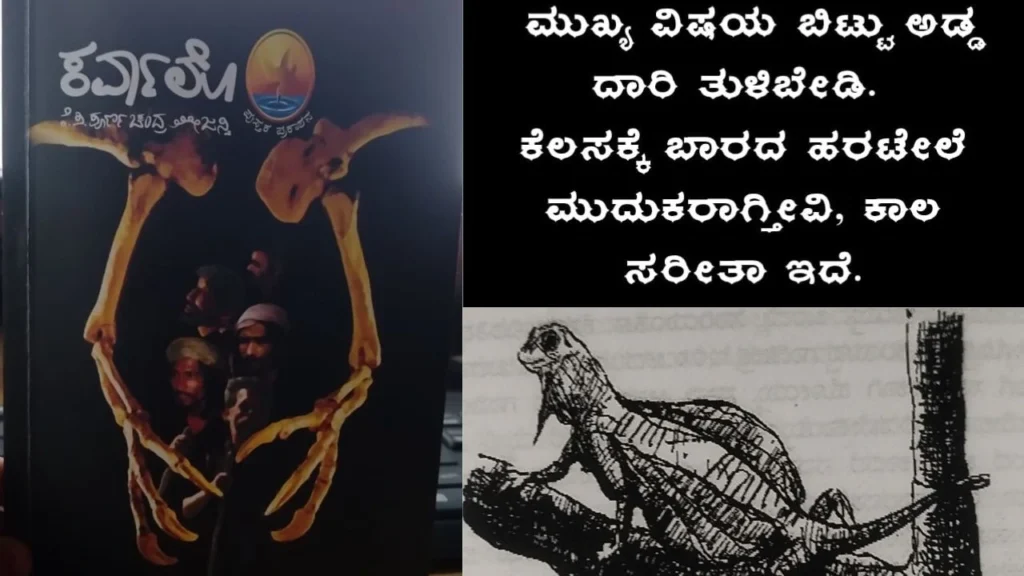
Karvalo is my second novel by Puchante – K.P. Purnachandra Tejaswi, after Jugari Cross. Like we all know, Karvalo is one of those novels which many Kannada readers choose to read early. It may not be my first Tejaswi book, but definitely one of the best reads so far. Why? You will understand it better only after you experience it yourself.
Karvalo starts in a small village in Malenadu, and initially it feels like a very simple village story. Tejaswi himself becomes the narrator here, an educated farmer struggling with agriculture and the problems that come with it. And then we meet Mandanna, Prabhakara, Kariyappa, Pyara and many other characters through his everyday life. Mandanna’s marriage with Raami, his troubles, village life, honey collection, farming, hunting and all those small incidents make the beginning quite funny and simple. I was enjoying all of this without really knowing where the story was going.
Then Karvalo enters the picture.
Karvalo is a scientist, and what makes his relationship with Mandanna interesting is that he sees something in him which other villagers don’t. Mandanna is mostly considered a good-for-nothing fellow by people around him. But Karvalo sees him differently. He understands that Mandanna has something very special — his observation. He can identify animals and understand the forest in a way that many educated people may not. For Karvalo, Mandanna is almost like a student and a naturalist.
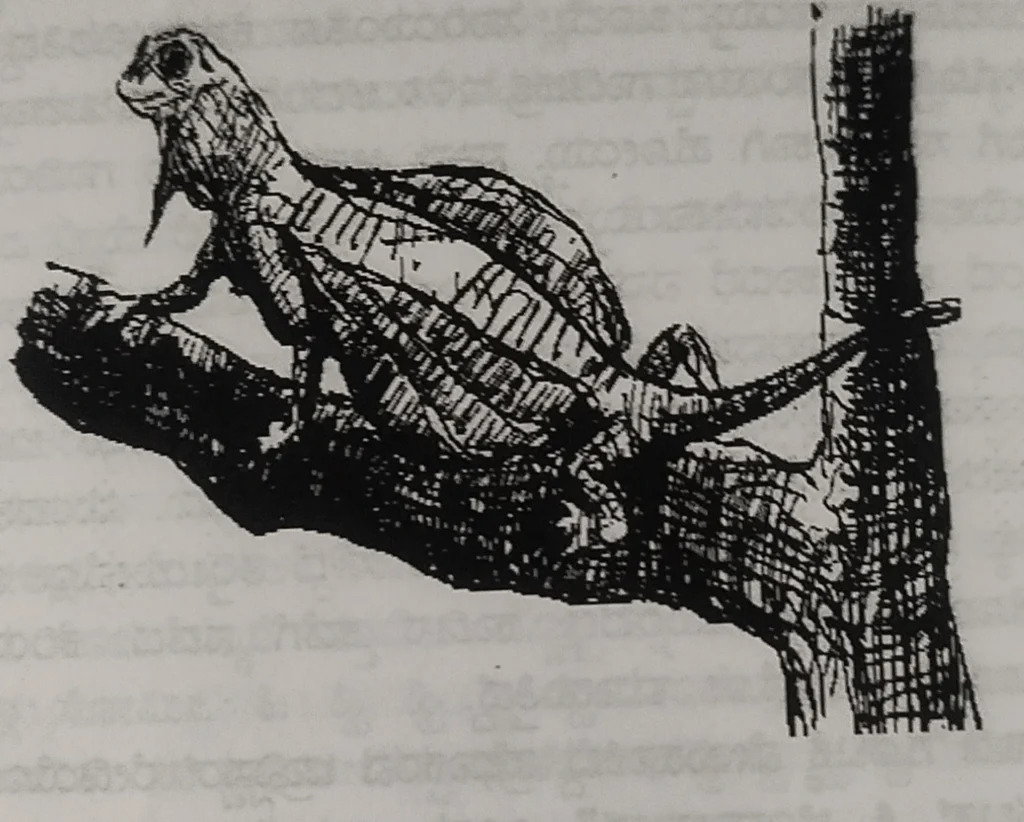
One day Mandanna tells Karvalo about a strange flying lizard which he has seen in the Narve forest. This is not an ordinary lizard. It is a rare flying or gliding lizard, and it was believed to be extinct. For Karvalo, this is enough to start a completely new journey. He wants to find out whether Mandanna is actually right.
And that becomes the main adventure of the novel.
Karvalo, the narrator, Mandanna, Prabhakara, Kariyappa and Kiwi, the narrator’s pet dog, set out into the forest in search of this mysterious creature. The expedition is one of the best parts of the book for me. The conversations between all of them, their different personalities, the difficulties inside the forest and the constant curiosity about whether they will actually find the lizard keep the story moving. Kiwi also becomes an interesting part of the journey, and Tejaswi’s observation of the dog’s behaviour makes even the animal feel like an important character.
And then there is Pyara, the narrator’s young helper. His way of speaking, with Kannada mixed with Hindi and Urdu, brings another kind of humour into the story. His reactions and the small conversations around him are genuinely funny. Along with Mandanna’s marriage episodes and Kariyappa’s hunting habits, these little things make the book feel like real village life rather than just a story written around a scientific expedition.
The Malenadu forest is almost another character in the book. While reading, I could actually imagine many of the scenes in front of me. The trees, insects, birds, rain, animals and the strange things happening inside the forest are described with so much observation that I often felt I was travelling with them. Many readers have also pointed out how the book’s scientific and environmental details make them curious enough to look up things outside the book.
In fact, I kept thinking that Karvalo would make a really good movie. It already has almost everything – nature, adventure, science, suspense, humour, drama and action. The forest expedition and especially the flying lizard scenes could be visually amazing. I honestly feel it can become a very interesting and commercially successful movie.
But the flying lizard is not really the whole point of the story.
As the journey continues, the search slowly becomes something much bigger. What do we really know about nature? How much of the world around us is still unknown? How did life evolve? What if evolution had taken another path? What if something we thought had disappeared was still alive somewhere?
These questions keep coming into the story without making it feel like a science textbook. There are also discussions about God, nature and science, where the same thing can be looked at completely differently by different people. One person can see nature and call it proof of God, while another can look at the same thing and say that nature itself is enough.
And I think that is where the real beauty of Karvalo is Curiosity. The book makes us realise that there is so much around us which we simply don’t notice because we have stopped looking closely.
I also liked the way Tejaswi sir has shown that knowledge doesn’t always come from books or education. Mandanna may not be an educated scientist, but his years of living close to the forest have given him an understanding that Karvalo values deeply. Instead of laughing at Mandanna like the others do, Karvalo listens to him. That itself says a lot.
And somehow, the book also made me look at ordinary people differently.
We usually think a suspense story needs a murder, robbery or some big crime to keep us interested. Karvalo has none of that. Still, it holds our attention till the end. We simply want to know what is inside that forest and whether the flying lizard really exists.
I started Karvalo thinking I was going to read a simple village story. Then it became a funny story about Mandanna and the people around him, then an adventure into the Malenadu forest, and slowly something much bigger about nature, science, evolution and our curiosity about the unknown.
They went looking for a flying lizard. But somewhere along the way, I felt that the real search was not just for the lizard. It was a search for knowledge, for something humans don’t completely understand yet.
And maybe that is why Karvalo stayed with many readers.
A simple story. A lot of humour. A beautiful forest. Some unforgettable characters. A strange flying lizard. And so many questions left behind.
