Book: Yaana (ಯಾನ)
Author: S.L. Bhyrappa
Language: Kannada
Genre: Philosophical Fiction / Science Fiction / Adventure
Publisher: Sahitya Akademi / Various editions
Pages: ~400–450 (may vary by edition)
Yaana by S.L. Bhyrappa Summary
Yaana by Dr. S.L. Bhyrappa is a very different kind of novel that takes us on a journey from Earth to the Proxima Centauri, where Uttara, a fighter pilot, and Sudarshan, a scientist, are chosen for a secret one-way space mission. They know they may never return to Earth and are expected to live together and help continue human life in space. As the journey progresses, the novel slowly moves beyond spacecraft, science and survival into love, duty, loneliness, morality, marriage, spirituality and human relationships. The story later moves to the next generation, Akash and Medini, bringing a difficult question about family, relationships and the responsibility of continuing the mission. Bhyrappa also takes the reader through Indian ideas of time, astronomy, spirituality and sacred places, making Yaana not just a journey through space, but an Antaranga yaana — an inner journey of human beings.
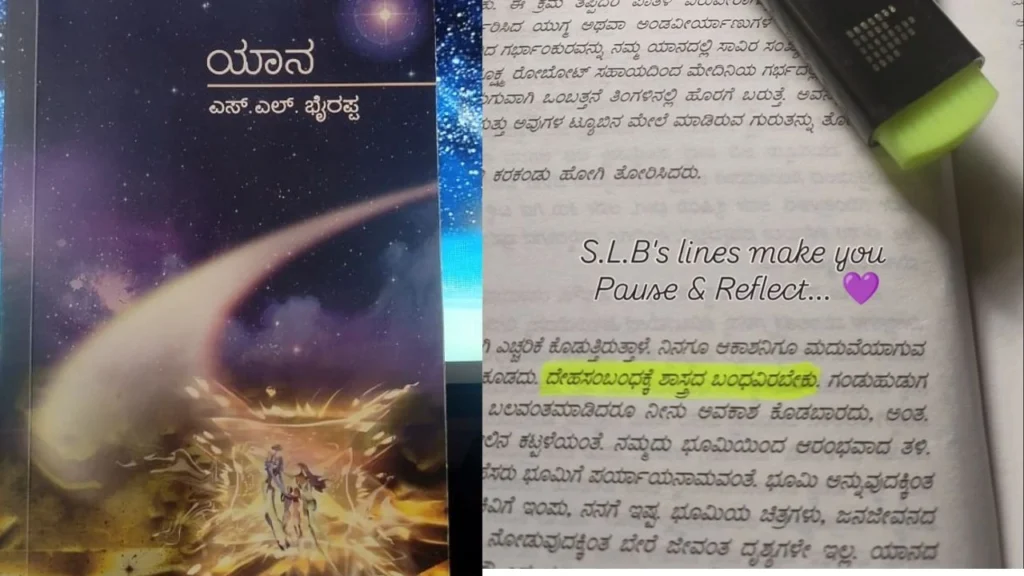
Now, read my completed & honest review on this below.
Every time I finish an S.L. Bhyrappa novel, I just sit and think for hours. One of the first thoughts that comes to my mind is, how much preparation this man might have done before writing such a book. His novels always make me feel that there is a lot of reading, research and thinking behind the story. And this time, I am talking about his very different novel – Yaana.
Yaana, published in 2014, was a very bold attempt by Bhyrappa. A writer whose novels are mostly known for human relationships, society, philosophy and the different shades of life suddenly moved into space, spaceships, astronauts and a journey towards Proxima Centauri. When I first started reading, I honestly felt a little bored. There was so much about the spacecraft, space travel and the technical side of the mission that I started wondering, how is all this going to help me? I even thought for a moment, did Bhyrappa ji make a mistake by writing a science fiction novel?
I was comparing it with his other novels like Grihabhanga, Vamshavruksha, Jalapatha and others. Those books immediately take us into human life. But here, I was sitting inside a spaceship with two astronauts and a lot of science.
But slowly, the book started changing.
What looked like a space mission in the beginning slowly became a story about human relationships, loneliness, duty, desire, morality and spirituality. That was when I felt relieved. I was back to the “S.L. Bhyrappa thing.”
One thing that increased my respect for this novel was the preparation behind it. Bhyrappa did extensive research before writing Yaana. He interacted with scientists and professors and spent time understanding space science and the problems involved in keeping human beings alive for years inside a closed spacecraft. His interactions with ISRO and IISc scientists are also a clear indication of how seriously he prepared himself for this subject.
And you can feel that preparation in the book. The spacecraft is not simply a machine travelling through space. There are arrangements for food, oxygen, water, plants and even growing vegetables. There is an attempt to imagine how human beings could survive in space for generations.
The story revolves around Uttara, a fighter pilot, and Sudarshan, a scientist. They are selected for a secret mission to Proxima Centauri, several light-years away from our solar system. Before leaving Earth, they know that this is a one-way journey. They are never going to return to earth, to their families.
The real purpose of the mission is much bigger than simply exploring space. They have to continue human life in space. Uttara and Sudarshan are expected to have children, raise them inside the spacecraft and prepare them for the next stage of the mission. Their children will then continue the same process for the next generation.
Everything looks planned perfectly on paper. But there is one problem.
Human beings are not machines.
Uttara already has a life on Earth. She is married to Yadav and has previously taken part in a space programme with him. When this new mission comes up, Yadav does not want to go, but Uttara accepts it. But even after leaving Earth, Uttara cannot leave Yadav behind emotionally.
His memories continue to trouble her. She cannot simply forget her previous life and behave according to the rules of the new mission. This becomes one of the major conflicts in the story.
Yadav’s life on Earth also becomes an important parallel to what is happening inside the spaceship. While Uttara is trying to adjust to a new life far away from Earth, Yadav has to continue living with the consequences of her decision. I liked this part because it reminds us that every big decision made for a mission or a larger purpose can also destroy someone’s personal life.
Inside the spacecraft, Uttara refuses to become pregnant. Sudarshan, who has dedicated his life to science and the mission, cannot understand her decision. He keeps trying to convince her about the responsibility they have taken. He argues with her, tries to change her mind and at times even becomes forceful and manipulative.
I did not always like Sudarshan in these portions. But that is also what makes the characters interesting. Bhyrappa doesn’t make it easy for us to decide who is right and who is wrong.
As the years pass, Sudarshan himself changes. After dealing with loneliness and frustration for a long time, he slowly moves towards meditation and spirituality in the spaceship, by studying through Mega computer. His thoughts during this phase were some of the most interesting parts of the novel for me.
This is also where Yaana starts feeling less like science fiction and more like a typical Bhyrappa novel.
The spaceship is still there, the mission is still going on, but the real story has moved inside the minds of the characters.
Later, Uttara changes her mind and finally accepts the responsibility of the mission, to bare kids. But by then Sudarshan has already changed. The man who once wanted her to fulfil the mission no longer wants the same thing.
Eventually, the problem of having children has to be solved because the entire mission depends on the next generation. This leads to the birth of two children, Akash and Medini.
And this is where the novel brings its biggest and most uncomfortable question.
Akash and Medini are expected to continue the mission and eventually marry each other.
Yes, brother and sister.
Obviously, this creates a huge dilemma. On Earth, such a relationship is completely unacceptable. But what happens when the rules of Earth are no longer enough to deal with the situation inside the spaceship?
This is probably the most interesting philosophical question in Yaana. Who decides what is right and wrong? Are our moral rules universal, or are they created according to the society and circumstances in which we live?
Akash and Medini naturally start questioning this. As they grow older, they begin looking into the lives of their parents and the history of the mission. They try to understand why they were born, what happened between Uttara, Sudarshan and Yadav, and why they have been given this responsibility.
Eventually, they discover the truth about their birth and realise that they are not biological siblings in the way they had believed. They were born using the reproductive material prepared for the mission.
This changes their dilemma, but it does not immediately make everything simple. They have grown up believing that they are brother and sister. So there is still an emotional and moral conflict. They question their parents and question the mission itself.
But after understanding everything that happened before them, they finally decide to continue the journey.
The ending does not clearly tell us everything. Whether they actually got married and exactly what happened afterwards is left to the reader’s imagination. I actually liked this because the novel ends with a question rather than giving us a completely fixed answer.
Another thing I liked in Yaana is the way S.L. Bhyrappa brings Indian ideas into a science-based story. His discussions about astronomy, Kaala or time, the Sun, stars and references such as Aditya Hridaya give the novel a different flavour. Some of these parts are slow, and I can understand why some readers may find them difficult. Even I felt the book became boring at certain points. But I was willing to continue because I knew there was more to the book than the science.
If someone asks me whether Yaana is a typical S.L. Bhyrappa novel, my answer would be both yes and no.
No, because the setting is completely different from what we normally expect from him. It is a science fiction novel and there are technical portions that are not his usual style.
But yes, because once we go deeper, everything is still very Bhyrappa. Human relationships, complicated emotions, loneliness, morality, duty, spirituality and the constant questioning of human behaviour are all there.
That is why I don’t think Yaana should be judged only as a science fiction novel.
For me, the spaceship is just the setting. The real story is about what happens to human beings when they are taken away from everything they know.
Uttara’s attachment to Yadav, Sudarshan’s loneliness and spiritual transformation, the difficult relationship between the two, and finally Akash and Medini’s confusion make the novel much more than a space journey.
There were definitely moments when I wanted to stop reading. The first few chapters especially were not easy for me. But I had this feeling that Bhyrappa would eventually bring me back to what I was expecting from him. Because, that is what happened in Doora Saridaru as well.
And he did.
The more I read Bhyrappa, the more I respect his thought process. His novels make me look at people differently and make me think about different shades of life. Even when I don’t agree with a character or his way of thinking, I end up understanding why that character behaved that way.
That was also my experience with Yaana.
I started the book wondering whether Bhyrappa had made a mistake by moving into science fiction.I finished it with even more respect for him.
He took me several light-years away from Earth, but in the end, he brought me back to the same place where most of his novels take me – the human mind.
And that is why Yaana stayed with me even after I finished it.
Slowly, I felt that Yaana is not just about a journey into space. It is also an antaranga yaana — an inner journey of human beings. The spacecraft is only the outer setting. The real journey is happening inside Uttara, Sudarshan and later Akash and Medini. Their ideas about love, duty, marriage, loneliness, morality, family, and spirituality change as they move farther away from Earth.
