Book: Mandovi (ಮಾಂಡವಿ)
Author: Ravi Belagere
Language: Kannada
Genre: Romance / Literary Fiction
Inspired by: Love in the Time of Cholera by Gabriel García Márquez
Setting: 1960s–70s, Bayaluseeme region of Ballari
Pages: Varies by edition
Mandovi Kannada Novel Summary
Mandovi by Ravi Belagere is a Kannada love story about Chalapati, a man who waits for 51 years to win back the love of Mandovi. But is waiting for someone for so many years enough to call it true love? While Chalam’s patience and determination are admirable, his relationships with other women and his disturbing actions towards a 16-year-old girl make us question his character. A story that begins as an emotional love story slowly turns into a complicated question about love, loyalty and human nature.
Now, read my completed & honest review on Mandovi below.
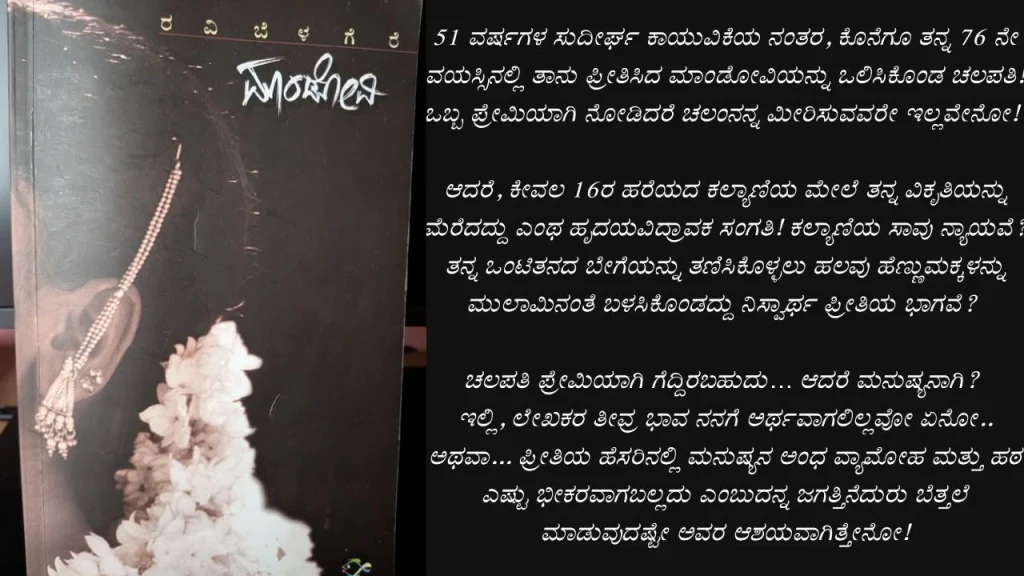
Just finished reading Mandovi by Ravi Belagere. I started this book almost two months ago, but in between, I lost interest in continuing it. Maybe because of a few incidents involving a character that I never expected. That shows how deeply we get connected to characters, even when we are reading fictional stories. Keeping that aside, I picked up the book again because I wanted to know what actually happened in the end.
Yes, Mandovi is another interesting love story by Ravi Belagere in Kannada. The book is inspired by Gabriel García Márquez’s Love in the Time of Cholera. I haven’t read many books by Ravi Belagere, except his all-time popular Heli Hogu Karana. Maybe because of that, I was suggested to read S. L. Bhyrappa’s Doora Saridaru and this one, Mandovi, by Bookstagram.
I started Mandovi with lots of expectations and enthusiasm. But that excitement didn’t stay with me till the last few pages. Maybe it is just my way of understanding the story. I seriously didn’t like the climax and the way Chalapati’s character turned out, especially because he was someone I actually liked from the beginning.
Set in the 1960s and 70s in the Bayaluseeme region of Ballari, Mandovi is a love story between two people from completely different backgrounds. Mandovi belongs to a well-to-do family, while our protagonist Chalapati (fondly called Chalam in the story) comes from a poor family and a different caste. He was raised by his single mother, Seetamma.
Chalam falls in love with Mandovi when he is 20 and she is just 16. Mandovi’s father, Shivarajappa, is a strict person when it comes to caste, family status and wealth. But that was not the actual problem between them. Mandovi, who spent almost three years exchanging love letters and secret meetings with Chalam, suddenly rejects him without giving any proper reason. Maybe, at that moment, she thought he was not worth her love, or perhaps she didn’t find him attractive enough (the way he is portrayed in that particular scene). Eventually, Mandovi marries Dr. Chennabasavana Gowda, a well-settled doctor in the town.
From that day, Chalam’s only goal in life is to reunite with Mandovi, make her accept his love and live with her. His love for Mandovi was so strong that he even wished for Dr. Chennabasavana Gowda to pass away, hoping that at least then Mandovi would come back to him.
He waited, and waited, and waited… Till when? Till he reached his 70s.
Yes, Chalam waited for Mandovi for 51 long years. He spent his life without marrying anyone, hoping that one day Mandovi would come back to him. At 76, he was still waiting for the woman he loved when he was just 20.
Till this point, the story felt very emotional to me. As a lover, there are probably very few who can match Chalam’s patience and determination. But things started changing when Chalam began having physical relationships with other women.
Maybe love is different and physical intimacy is different. But can we really separate the two when we talk about true love? How can someone be called a great lover who waited for more than half a century for one woman, while also having relationships with other women during the same period? Is it a part of his loneliness, or just the satisfaction of his own desires? Can we still call it selfless love?
Meanwhile, after Mandovi marries another man, Chalam starts rebuilding his life. He works hard, takes care of his health and maintains his body. He joins his uncle’s travel agency (Motor Service) and becomes an owner within a few years. He earns a lot of wealth and status in the same society where his love was once rejected.
One day, he finally gets to hear the news he had been waiting for his whole life — the death of Dr. Chennabasavana Gowda. He isn’t sad. Instead, he is happy that finally, at the age of 76, he has a chance to impress Mandovi again and make her accept his love. Mandovi is 72 by then.
Will he get Mandovi back in his life? Will Mandovi ever accept Chalam’s love again? What about society and Mandovi’s son and daughter? And what was the actual reason behind her rejecting him during her teenage years? I will leave these questions unanswered for those who haven’t read the book.
After reading the climax, one question that kept coming to my mind was — Was Chalam ever worth all this love?
Maybe Mandovi was right in rejecting him, even though she might not have known the exact reason at that time. If she had known about his physical relationships with different women, would she have still considered accepting his love? Would she have looked at him in the same way?
The most heart-wrenching part of the story for me is Kalyani. A 16-year-old girl studying at a London Missionary School, who was also a distant relative of Chalam. He was supposed to be her guardian, someone she could trust. But what he did to her was something I could never accept, especially as a woman. It was deeply disturbing to read.
Chalam might have won Mandovi’s love after waiting for 51 long years. As a lover, perhaps there are very few who can match him. But what about the other women in his life? What about Kalyani? Does waiting for one woman for so many years make all his other actions acceptable? Chalam might have won as a lover, but did he win as a human being?
I don’t know if I understood the story the way Ravi Belagere wanted his readers to understand it. Maybe every reader has a different way of looking at a character. Some may see Chalam as a man who waited for his love for more than 50 years. But I found it difficult to see him as a great lover after knowing everything about his character.
I still appreciate Ravi Belagere’s storytelling and the way he keeps the reader curious about what happens next. The book definitely makes you think about love, relationships, loyalty, loneliness and human desires. It may not be a story that I completely loved, but it is definitely one that made me think.
Sometimes, we don’t dislike a book. We just cannot accept what the characters become by the end of it.
And Mandovi was one such reading experience for me. I started it with lots of expectations, got emotionally connected to Chalam, but finished it with mixed feelings and many unanswered questions.
